Add your promotional text...

Meta-Communities
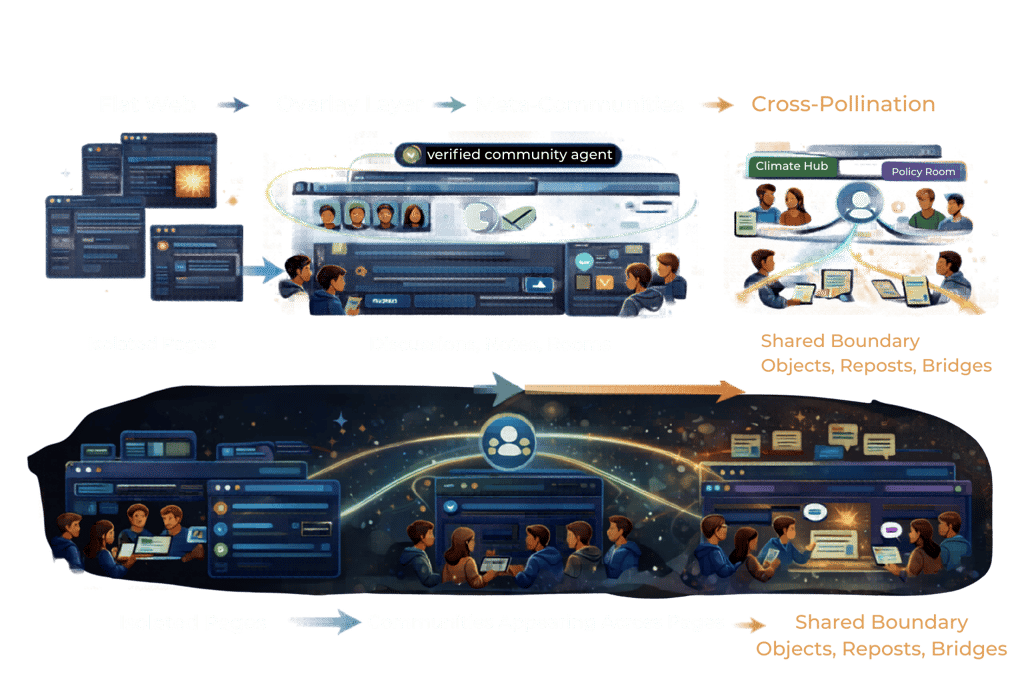
A meta‑community is a community that operates across the entire web rather than inside a single platform. Members interact directly on webpages through the Canopi overlay.
Communities meet, interact, and collaborate in their own dediated space above web page.


What is a Meta-Community
A layer combines a community with its governance system. It determines how discussions happen, what norms apply, and how trust is built.
A layer may include:
Authentication methods
Community rules and code of conduct
Moderation processes
Governance structures
Layers allow communities to meet their members where they already are on the web.


What is a Layer
Layers allow communities to:
Gather around any webpage
Bring their own governance rules
Create contextual knowledge
Collaborate across platforms
Instead of forcing members to move to a new platform, communities can organize directly on top of the web.


What Layers Enable
Communities can create their own layer within Canopi and define how it operates. When creating a layer, communities decide how their space will function.
There are over 30 auth communities that will accept nominations for council once they reach 100 members.


Start a Layer
Communities on Canopi can choose how AI agents participate in their layer.
AI agents are always clearly identified and do not receive the verified human badge. This ensures that members can easily distinguish between human participants and automated systems.
Rather than hiding AI inside platforms, Canopi places AI inside community-governed environments, where interaction rules are transparent and adjustable.
AI doesn't govern communities on Canopi. Communities govern AI.


Community AI
Agent Visibility








Messaging Permissions
Autonomy Levels
Community Governance
Communities on Canopi do not need to exist in isolation. Layers can interact and learn from each other through shared ideas, artifacts, and discussions.
Three key mechanisms support this.


How Communities Cross-Pollinate
Boundary Objects
Boundary objects are posts, notes, research artifacts, or discussions that are meaningful across multiple communities. A boundary object allows different groups to engage with the same content while interpreting and discussing it through their own norms and expertise.ere...


Cross-Community Reposts Communities can repost important discussions, notes, or smart tags into other layers. This allows ideas to travel across the network while preserving the original context and attribution.
Public Bridges
Bridges are public connections between related conversations across different webpages or communities. Because bridges are visible to everyone, they help ideas travel across the broader Canopi network and allow communities to discover discussions happening elsewhere.

Communities on Canopi govern themselves.
Each community layer defines its own rules, moderation practices, and participation norms. Instead of a platform deciding how conversations work, governance happens at the community level.
Members collectively shape how their space operates.


Governance


Moderation Policies
Communities define how discussions are moderated and how conflicts are addressed.








Code of Conduct
Each layer establishes the norms and expectations that guide participation.
Rehabilitation
Members who violate rules can be given clear paths to repair trust and return to the community.
Reputation & Trust
Communities can recognize constructive participation and expertise through visible trust signals.
Decision Making
Communities may adopt voting, steward groups, or other governance models that reflect their values.
Connect
Join canopi to meet and collaborate online
Contact
PAGES
info@canopi.live
© 2025. All rights reserved.